


Inside the IDN Roadmap: A Strategic Guide for Pharmaceutical Marketers
October 31, 2025
-
Share
Now -

-

-

-


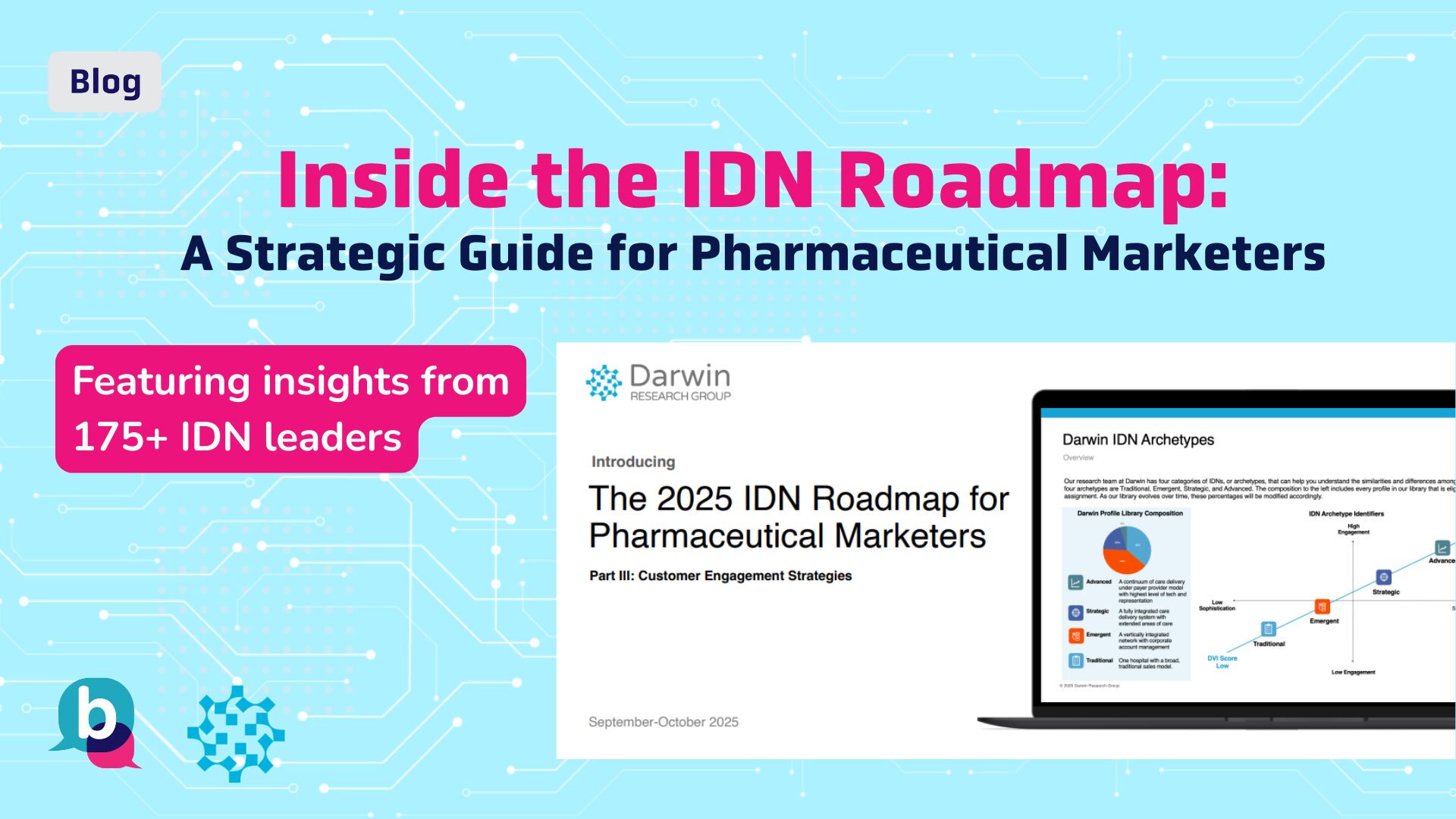
Featuring insights from 175+ IDN leaders – download the report
Pharmaceutical marketers are entering a new era of engagement. Integrated Delivery Networks (IDNs) now employ more than 77% of physicians in the United States making them the central gatekeepers of prescribing decisions, patient pathways, and formulary access. At the same time, value-based care and rapid technology adoption are redefining how these systems operate.
For pharma, this means the old playbook—mass outreach, rep-driven education, one-size-fits-all messaging—is no longer enough. What IDNs want today is tailored, collaborative engagement that aligns with their clinical, operational, and financial goals. And increasingly, AI is becoming an important enabler of new engagement models, alongside trends like segmentation, collaboration, and outcomes-driven partnerships. That was the focus of Inside the 2025 IDN Roadmap: Trends and Pharma Engagement Strategies That Work, a webinar hosted by Botco.ai and Darwin Research Group. The panel featured John Marchica, CEO of Darwin Research Group, who led the research behind the 2025 IDN Roadmap study, and Rebecca Clyde, CEO of Botco.ai. Drawing on insights from 50+ in-depth interviews and 125+ surveys with IDN executives, they painted a forward-looking picture of where pharma-IDN engagement is headed—and how pharma marketers should prepare.
Here’s a comprehensive recap. Even if you missed the webinar, this will give you the insights you need to plan your 2026 roadmap.
What IDNs Want: Updated Expectations
The first question many pharma leaders ask is: what do IDNs actually want from us now? The answer has shifted dramatically since pre-pandemic years.
As John Marchica explained, “IDNs don’t just want another lunch-and-learn. They want real collaboration—support with patient education, adherence programs, and outcomes-driven initiatives.”
Rebecca Clyde emphasized that compliance and personalization can coexist. “One pitfall I see is using outdated outreach methods—like generic messaging,” she said. “With AI, you can remain compliant while still being personalized and relevant, but many teams aren’t yet using that advantage.”
This is already happening in the clinical trial space. For example, UCLA partnered with Botco.ai to match patients into clinical trials more quickly. By using AI-powered chat, oncologists could input patient details in real time and receive trial options in under two minutes. The result: better referral rates, less burden on providers, and improved access for patients who might otherwise be overlooked.
Takeaway: Pharma reps must evolve into consultative partners, offering data, insights, and programmatic support that align with IDN goals. Clinical trial collaboration shows what’s possible—and scalable—when engagement is tailored and tech-enabled.
Strategic Segmentation: Using Archetypes to Guide Engagement
Darwin’s research introduced IDN archetypes as a framework for engagement. Not every IDN is the same, and treating them as such wastes resources.
Marchica put it plainly: “Not all IDNs are created equal. A national IDN with sophisticated tech infrastructure looks very different from a regional one still modernizing its EHR. Engagement strategies need to reflect those differences.”
Clyde echoed the importance of segmentation, not just for efficiency but for credibility. “If you know which archetype you’re dealing with, you can tailor both the message and the channel to meet them where they are,” she said.
Broader Relevance:
This segmentation mindset applies beyond pharma. Payers, medtech firms, and even digital health startups often lump IDNs together. Archetypes provide a roadmap for anyone trying to build partnerships with complex, multi-layered systems.
Takeaway: Archetypes give pharma marketers a practical tool to align engagement strategies with IDN maturity and needs.
Trends Driving Change: Data, AI, and Value-Based Care
When asked which forces are shaping the IDN landscape most, Marchica didn’t hesitate: “Policy changes, technology modernization, and value-based care are all reinforcing each other. The IDNs that are ahead on these fronts are pulling away from those still catching up.”
Clyde emphasized how AI is accelerating this shift: “We’ve seen AI agents already being deployed for patient education, adherence, and even provider engagement. In behavioral health, AI is filling gaps where staffing shortages are severe—this has clear parallels for pharma-IDN engagement.”
One recent example is the use of an AI-powered vaccination chatbot to support immunization programs. The bot engaged patients through SMS, reminding them of upcoming vaccine schedules, addressing misinformation with evidence-based answers, and connecting them to nearby providers. By reducing missed vaccinations and increasing timely adherence, the chatbot didn’t just serve patients—it also demonstrated how pharma and IDNs can collaborate to achieve public health goals.
Takeaway: AI is no longer a future concept. It is already shaping how IDNs engage with patients, providers, and industry partners. Pharma teams that experiment now with compliant, scalable AI will be better positioned.
Avoidable Pitfalls
The 2025 Roadmap research also revealed where pharma often stumbles. Misalignment across internal teams—market access, medical, and commercial—remains one of the biggest issues.
Marchica warned, “Fragmentation within pharma slows execution. When your market access team, medical affairs, and sales reps aren’t coordinated, IDNs feel it—and it erodes trust.”
Clyde framed it as a leadership challenge: “Leaders who experiment now with segmentation, automation, and real-time engagement will be positioned ahead of peers who wait.”
The Roadmap data reinforces this. When IDN executives were asked about barriers to partnering with pharma, the top challenges were clear: data sharing (85%), regulatory and compliance concerns (79%), and staffing/resource constraints (66%). Trust in the manufacturer also scored high, underscoring that missteps in engagement have lasting consequences.
Broader Relevance:
This isn’t unique to pharma. Health tech vendors and service providers face the same problem. When internal silos spill into external engagements, IDNs lose confidence.
Takeaway: Internal alignment is a prerequisite for external credibility. Pharma teams must coordinate before approaching IDNs, or risk undermining hard-won relationships.
Real-World Strategies: Scaling with AI Agents
So how can pharma scale personalized, compliant engagement across dozens of IDNs without blowing up budgets or compliance risk? Enter AI agents.
Clyde offered a practical example: “In our work, we’ve seen that AI agents can deliver education, escalate when necessary, and log interactions for full auditability. That means you can scale compliant engagement in ways that human-only teams simply can’t.”
Marchica underscored the efficiency angle: “IDNs have an appetite for collaboration, but compliance and budget constraints are roadblocks. AI offers a way to meet those demands more efficiently.”
Beyond AI, Darwin’s research also highlighted the opportunity to co-develop patient-support programs (PSPs). Executives rated PSPs as “high importance” and “high impact on outcomes,” particularly for vulnerable populations. Transportation assistance, copay support, and navigation services were seen as areas where pharma could add real value. While implementation can be challenging, the likelihood to pursue PSPs was very high—making them a clear low-hanging fruit for engagement.
Leadership Checklist for 2026
For pharma leaders planning their next phase of IDN engagement, here’s a concise action plan drawn from the discussion:
- Segment before you engage. Use IDN archetypes to focus resources where they’ll have the most impact.
- Upgrade outreach. Retire generic messaging; lean into tailored, compliant communications.
- Fix internal silos. Align market access, commercial, and medical before meeting IDNs.
- Experiment with AI now. Start small—education, adherence, or provider Q&A—but start.
- Build for compliance. Governance and auditability aren’t add-ons; they’re the foundation.
- Track outcomes, not just activity. Measure patient support, adherence, and value creation.
Final Word
Pharma-IDN engagement is being reshaped by consolidation, value-based care, and AI. As Marchica summed up, “Policy, technology, and value-based care are converging—and that convergence is reshaping what IDNs expect from pharma.”
Clyde closed with a reminder that innovation and compliance must move together: “Data governance and compliance can’t be afterthoughts. They’re the foundation that allows you to scale responsibly.”
For pharma marketers, the message is clear: the roadmap for 2026 is already being drawn. The time to act is now.