


How AI Agents Can Support Adverse Event Reporting Without Increasing Risk
August 23, 2026
-
Share
Now -

-

-

-


AI agents can support adverse event reporting by detecting potential safety information, collecting and structuring case data, routing it into pharmacovigilance workflows, and escalating cases for human review. The opportunity is significant, but so is the risk if AI is allowed to make decisions that belong to qualified pharmacovigilance professionals.
Pharmaceutical companies now receive safety-relevant information across more channels than ever: patient support programs, call centers, websites, email, SMS, social media, digital platforms, EHR-connected programs, and increasingly, AI-powered conversations.
The revised ICH E2D(R1) guideline officially came into effect in the EU on March 18, 2026, with a six-month implementation transition period through September 18, 2026. The revision reflects this changing environment, including the growing role of digital platforms, mobile health technologies, patient support programs, market research programs, and other organized data-collection systems in post-approval safety information.
That changes the problem.
The challenge is no longer simply collecting adverse event reports through traditional channels. It is recognizing potentially important safety information wherever it appears and moving it into the appropriate pharmacovigilance workflow without creating additional risk.
That is where AI agents can add value.
Where AI Can Add Value in Adverse Event Reporting
Adverse event case processing remains one of the most resource-intensive parts of pharmacovigilance.
A Pfizer-funded pilot published in Clinical Pharmacology & Therapeutics found that case-processing activities can account for a substantial share of internal PV resources and that automation represents a significant opportunity to reduce this burden. The study tested AI and robotic process automation for adverse-event case processing and found that AI-based tools could support extraction of critical information from source documents and evaluation of case validity.
The same study also highlights why this is not a simple automation problem.
Adverse-event case processing spans four major activities—intake, evaluation, follow-up, and distribution—and includes multiple process steps that have traditionally required significant manual work.
That is precisely why AI agents are helpful here.
They do not need to replace the entire pharmacovigilance process.
They can support specific, repetitive, high-volume parts of the workflow while keeping clinical judgment and regulatory accountability with qualified teams.
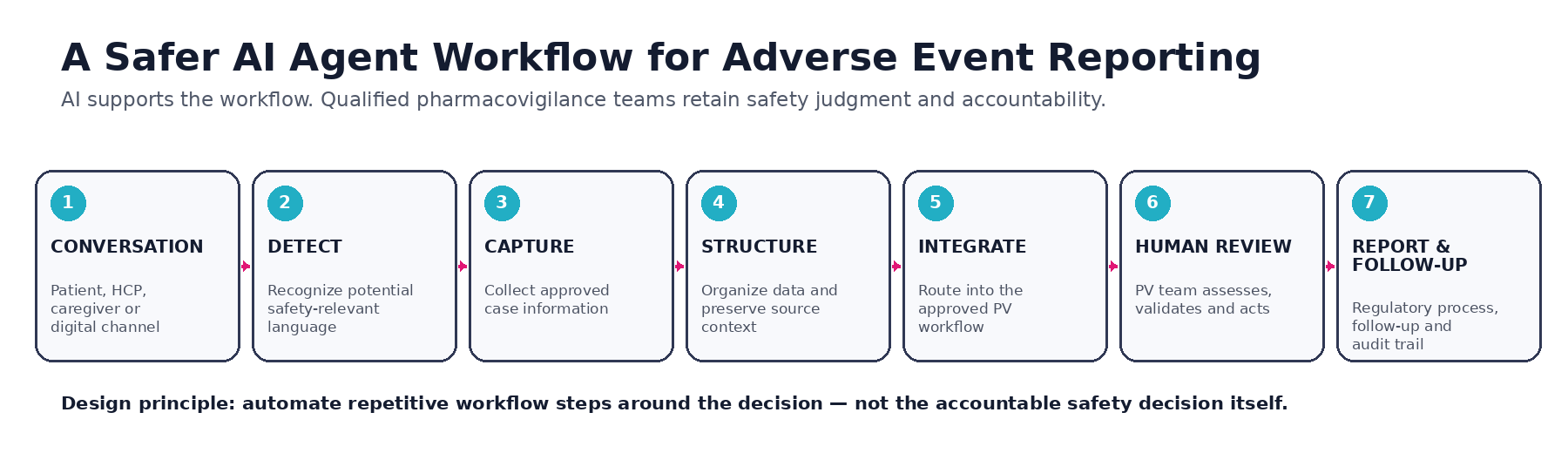
Where AI Agents Can Help
1. Intake Unstructured Safety Information
The first challenge is that adverse-event information rarely arrives in neat, structured fields.
It may appear in:
- Patient emails
- Call center transcripts
- Chat conversations
- SMS messages
- EHR notes
- Patient support programs
- Medical literature
- Digital communities
A patient may say:
“I’ve been feeling dizzy ever since I started taking this.”
That is very different from a structured safety report.
The Pfizer pilot is especially relevant here because it demonstrated that machine-learning tools could extract important case information from largely unstructured source documents. It also noted that natural language processing and text mining had already been applied to drug labels, scientific publications, patient records, and social-media content.
For an AI agent, the practical use case is simple:
Listen for potentially safety-relevant information wherever the conversation is already happening.
The goal is not to make a safety judgment. It is to make sure the signal does not disappear inside an ordinary customer or patient conversation.
2. Understand Context, Not Just Keywords
Simple keyword detection is not enough.
A patient might say:
“My ears have been buzzing since the new medication.”
A keyword system may miss that entirely.
A more contextual AI system can evaluate the surrounding language, patient timeline, symptoms, product information, and other relevant details before deciding whether the conversation should enter an adverse-event workflow.
This is already how Botco.ai is approaching the problem. We use natural language processing and machine learning to detect potential adverse events while analyzing surrounding context rather than relying solely on keywords. The workflow then escalates potential events for human review.
For pharma organizations, that distinction is important.
The goal is not to maximize keyword matches. It is to improve sensitivity without flooding PV teams with unusable false positives.
That balance between recall and precision matters enormously in a safety environment.
3. Collect the Minimum Information Needed
Once an AI agent detects a potential adverse event, the next step is not to provide a generic response.
The interaction should switch into an approved safety workflow.
The Pfizer pilot defined case validity using four core elements:
- An adverse event
- A suspected drug
- An identifiable patient
- An identifiable reporter
An AI agent can help gather those elements consistently.
For example:
Patient:
“I started getting a rash after beginning the medication.”
AI Agent:
“I’m sorry you’re experiencing that. I’d like to collect a few details so the appropriate safety team can review this.”
From there, the agent can follow a controlled workflow to gather the information required by the company’s process.
The key word is controlled.
The AI should not improvise a clinical investigation.
The conversational layer can feel natural, but the underlying workflow should follow approved rules.
4. Convert Conversations Into Structured Case Data
One of the most useful things AI can do is transform unstructured conversation into structured data.
Instead of asking a PV professional to manually re-read a transcript and enter every field into another platform, an AI agent can help organize information into predefined categories such as:
- Patient
- Product
- Event
- Reporter
- Timing
- Relevant history
- Follow-up requirements
AI can extract multiple specific data elements from safety case documents, including adverse-event text, suspect drug, patient demographics, and reporter details.
This does not remove human review.
It improves what reaches the reviewer.
That can reduce manual transcription, improve consistency, and shorten the distance between the original report and the pharmacovigilance team.
5. Automate the Workflow Around the Case
This is where an AI agent becomes meaningfully different from a traditional chatbot.
Recognition alone has limited value.
Imagine this experience:
“This may be an adverse event. Please call our safety department.”
The AI technically identified the issue, but it also created another step for the patient and another disconnected workflow for the company.
A properly integrated AI agent can do more.
It can:
Detect → Capture → Structure → Log → Route → Escalate
That may include pre-populating fields, creating an internal case or task, transferring the transcript, notifying the right team, or writing information into an approved tracking environment.
This kind of architecture is its own adverse-event workflow, where potential events are flagged and escalated to human teams, with API connections and CRM integrations allowing safety information to move into existing workflows.
Do not add another AI interface. Connect the AI to the workflow that already exists.
6. Support Standardized Medical Coding
AI can also assist with one of the more repetitive parts of case processing: mapping free-text information into standardized terminology.
Pharmacovigilance operations commonly rely on controlled vocabularies such as MedDRA for consistent coding of adverse-event information.
AI and NLP systems can help suggest mappings from conversational descriptions to standardized terms, allowing PV professionals to review rather than manually begin every coding task from scratch.
This is another area where the distinction between assist and decide matters.
The AI can accelerate the administrative process.
Qualified reviewers still own the final coding and interpretation where required.
7. Improve Follow-Up
Adverse-event reports are often incomplete.
That creates another strong use case for AI agents.
If predefined information is missing, an agent can support structured follow-up.
For example:
“You mentioned the reaction began last week. Do you remember approximately when you started the medication?”
or:
“May we contact you again if the safety team needs additional information?”
Rather than replacing the PV professional, AI can reduce the administrative effort required to identify incomplete information, initiate outreach, log attempts, and preserve responses.
8. Support Proactive Signal Detection
The most ambitious use case goes beyond individual case intake.
AI can scan larger volumes of real-world and digital information to identify patterns that may deserve further investigation.
Research cited in the Pfizer paper has explored machine learning and text mining for safety signals across patient records, scientific literature, spontaneous reporting systems, and social-media data.
That does not mean an AI agent should independently declare a safety signal.
It means AI can help PV teams find the needle in the haystack faster.
That could include surfacing:
- Unusual symptom clusters
- Repeated descriptions of the same event
- Changes in event frequency
- Emerging language not covered by existing keyword lists
- Potential cases buried in high-volume digital data
The result is earlier visibility for the human teams responsible for assessment.
The Safety Boundary: What AI Should Not Own
This is where pharma organizations need to be disciplined.
The strongest adverse-event AI architecture does not try to automate everything.
A practical division looks like this:
| AI Agents Can Support | PV Professionals Should Own |
| Detecting potential AE language | Clinical assessment |
| Extracting structured information | Causality assessment |
| Pre-populating case fields | Final case evaluation |
| Identifying missing information | Regulatory interpretation |
| Supporting MedDRA coding | Final coding approval where required |
| Routing and escalation | Exceptions and ambiguous cases |
| Follow-up workflows | Safety judgment |
| Audit logging | Regulatory accountability |
| Pattern detection | Signal evaluation |
The underlying principle is simple:
Automate the repetitive work around the decision, not the accountable decision itself.
Why Integrations Matter More Than the Model
Many organizations focus first on model accuracy.
That matters.
But for adverse-event reporting, integrations may be just as important.
If an AI agent detects a potential adverse event but cannot move the information into the organization’s existing safety workflow, the result is still manual work.
A useful architecture connects the engagement layer to systems such as:
- Safety databases
- CRM platforms
- EHR systems where appropriate
- Case-management platforms
- Contact-center systems
- Approved knowledge sources
The AI becomes the connective layer between the original conversation and the regulated process behind it.
That is much more valuable than a chatbot that simply recognizes safety language.
How to Build an Adverse Event AI Agent Without Increasing Risk
A practical implementation model looks like this:
Step 1: Define the exposure
Identify every channel where the AI could encounter adverse-event information.
Chat?
Voice?
SMS?
Patient support?
HCP engagement?
Email?
Digital programs?
Step 2: Define the trigger
Establish the language, contextual cues, rules, and model thresholds that move a conversation into the safety workflow.
Step 3: Define the approved intake
Determine exactly what the agent may ask and what information needs to be collected.
Step 4: Define the system action
Where does the information go?
Who receives it?
Does the case enter a database?
Does a human reviewer receive the complete transcript?
Step 5: Define the human boundary
Specify what requires PV review and what the AI must never decide independently.
Step 6: Test for false negatives
This may be more important than testing whether the bot sounds natural.
The Pfizer pilot specifically noted that for a production system used in a regulatory environment, sensitivity thresholds would need to be sufficiently high to minimize the risk that valid AE information is missed.
Step 7: Preserve the audit trail
Organizations should be able to reconstruct:
- What the patient said
- What the system detected
- What questions were asked
- What information was extracted
- What action was taken
- When escalation occurred
- Who reviewed the case
That is what makes AI support defensible rather than opaque.
A Simple Example
Imagine a patient-support AI agent helping someone understand medication access.
The conversation begins normally.
Patient:
“Can you tell me whether my insurance covers this?”
The agent retrieves the relevant information and assists.
Then the patient says:
“Also, I’ve been feeling extremely nauseous since I started taking it.”
The system recognizes a potential adverse event.
It does not continue casually.
It initiates the safety workflow.
The agent collects the approved information.
The conversation is structured into the appropriate case fields.
The complete transcript is retained.
The case is routed to the designated safety team.
The patient receives confirmation that the information has been passed along.
The PV professional reviews the case.
That is what a well-designed AI agent looks like.
It does not replace pharmacovigilance. It makes sure pharmacovigilance enters the conversation at the right moment.
Frequently Asked Questions
Can AI identify adverse events from patient conversations?
Yes, AI and NLP systems can help identify potential adverse-event information in unstructured text and conversations. Research has demonstrated the feasibility of extracting adverse-event information from safety documents and other unstructured sources. However, production systems require careful validation and high sensitivity so valid events are not missed.
Can AI agents automatically report adverse events?
AI agents can support detection, intake, structuring, routing, and workflow automation. Whether an adverse event meets reporting requirements and how it must be submitted depends on the applicable regulatory framework and the organization’s pharmacovigilance process.
What are the core elements of a valid adverse-event case?
The Pfizer pilot used four elements to determine case validity: an adverse event, a suspected drug, an identifiable patient, and an identifiable reporter.
How can AI reduce false positives in adverse-event detection?
Contextual NLP and machine-learning approaches can evaluate surrounding language rather than relying solely on keyword matching. AI systems can also be trained against product-specific and historical safety data. Human review remains important for validating potential cases.
Should AI make final pharmacovigilance decisions?
AI is better suited to supporting repetitive, structured tasks such as detection, extraction, intake, routing, and follow-up. Clinical assessment, regulatory interpretation, exceptions, and accountable safety decisions should remain within qualified pharmacovigilance processes.
Can AI monitor adverse events across digital channels?
AI can support monitoring across digital sources, but the regulatory obligations depend on the type of platform and whether it is under the marketing authorization holder’s responsibility. ICH E2D(R1) provides specific guidance for digital platforms and organized data-collection systems.
Build Safety Into the Workflow
Botco.ai’s Safety Reporting Agent is designed to help capture, triage, and report adverse-event information while supporting pharmacovigilance workflows.
The opportunity is not to replace the PV team.
It is to make sure the right information reaches them earlier, more consistently, and with less manual friction.
Talk to Botco.ai about building AI agents for safer, more connected pharma engagement.
Sources
- Schmider J, Kumar K, LaForest C, et al. “Innovation in Pharmacovigilance: Use of Artificial Intelligence in Adverse Event Case Processing.” Clinical Pharmacology & Therapeutics, 2019.
- U.S. Food and Drug Administration. “Postmarketing Adverse Event Reporting Compliance Program.
- ICH E2D(R1), “Post-Approval Safety Data: Definitions and Standards for Management and Reporting of Individual Case Safety Reports.”
- ICH E2D(R1), Digital Platforms guidance.