Voice AI Has Reached a Tipping Point: What Businesses and Consumers Actually Think
July 20, 2026
-
Share
Now -

-

-

-


Voice AI is no longer an emerging technology. It has become an enterprise priority.
Organizations across healthcare, financial services, government, education, and customer service are deploying AI-powered voice agents to automate appointment scheduling, customer support, intake, lead qualification, after-hours coverage, and routine service requests. At the same time, consumers have become increasingly comfortable speaking with AI in their daily lives.
But widespread adoption doesn’t automatically create trust.
That was one of the clearest themes from Botco.ai’s latest research report, The State of Voice AI: Adoption, Expectations and Trust, which surveyed more than 400 business leaders and consumers to better understand how Voice AI is being adopted, what customers expect, and where organizations are succeeding—or falling short.
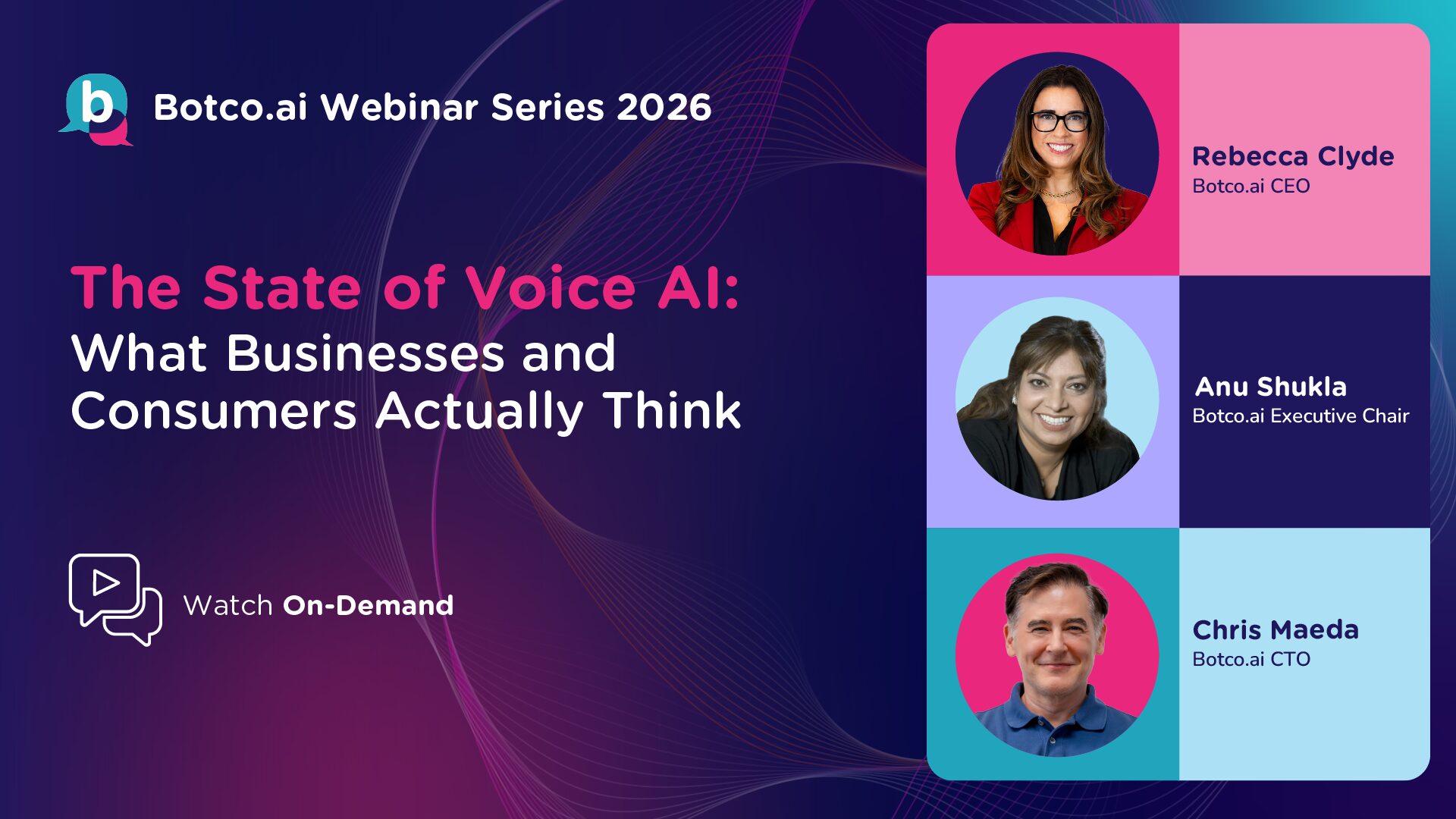
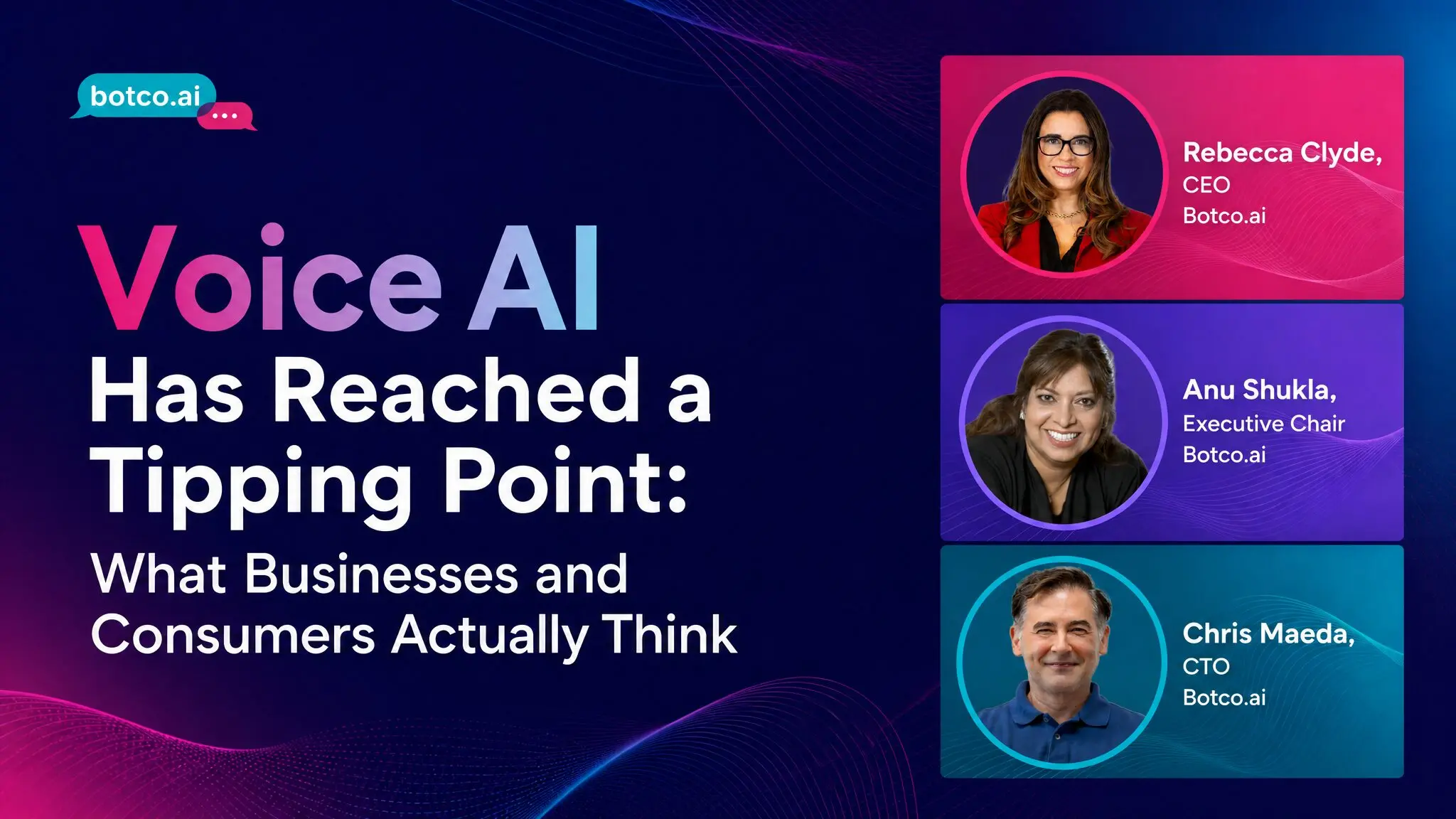
These findings were explored during Botco.ai’s webinar, The State of Voice AI: What Businesses and Consumers Actually Think, featuring Rebecca Clyde, CEO of Botco.ai; Anu Shukla, Executive Chair; and Chris Maeda, CTO.
The discussion made one thing clear.
The challenge is no longer whether Voice AI works.
The challenge is whether organizations can implement it in ways that customers trust.
The companies that succeed won’t necessarily be the first to deploy Voice AI. They’ll be the ones that combine strong technology with thoughtful implementation, clean data, cross-functional collaboration, and a relentless focus on customer outcomes.
Voice AI Has Officially Moved Beyond Experimentation
Only a few years ago, Voice AI was viewed as an emerging capability. Today, organizations are actively investing in enterprise deployments. According to Botco.ai’s 2026 State of Voice Agents report, 46% of businesses have already deployed or are actively piloting voice agents — meaning enterprise adoption has crossed the halfway mark from experimentation into production.
Consumers are evolving just as quickly. According to Botco.ai’s 2026 State of Voice Agents report, 73% of consumers use voice agents at least occasionally — making it a mainstream channel, not an emerging one., whether through virtual assistants, customer service interactions, or business applications.
For Rebecca Clyde, the strategic implication is practical:Nearly half of businesses have already deployed or are piloting Voice AI
“Especially if this is your first time implementing a voice AI channel, start with a warm or qualified lead first. Context is everything — the AI needs something to work with.”
— Rebecca Clyde, CEO, Botco.ai
That shift changes the conversation for business leaders. The question is no longer Should we explore Voice AI? Instead, organizations need to ask: Where can Voice AI create measurable business value while improving the customer experience?
“If your board or your C-suite is looking at high ROI, start there.”
Many organizations begin evaluating AI by asking how much money they can save.
Rebecca Clyde believes they’re asking the wrong question.
Rather than viewing Voice AI primarily as a cost-reduction tool, organizations should first identify where it can generate revenue.
During the webinar, she pointed to scheduling and intake as one of the highest-value starting points.
“Scheduling and intake is a really important one because it contributes to revenue.”
She expanded on that idea.
“Every person that you miss that is trying to reach you to schedule an appointment is a missed revenue opportunity. If you can streamline intake and scheduling, you’re going to increase your top line, which automatically makes this a high ROI investment.”
That insight applies well beyond healthcare.
Whether an organization schedules appointments, demos, consultations, service calls, or customer meetings, every unanswered inquiry represents potential lost business.
Voice AI helps capture those opportunities around the clock while reducing wait times and improving accessibility.
Rebecca summarized the business case simply:
“If your board or your C-suite is looking at high ROI, start there.”
Organizations that begin with measurable, revenue-generating workflows are more likely to demonstrate success early, build executive support, and expand AI initiatives strategically.
Trust Has Become Voice AI’s Biggest Competitive Advantage
While businesses often focus on automation and efficiency, consumers judge Voice Agents differently.
According to Botco.ai’s research, accuracy is by far the most important factor influencing customer satisfaction.
Customers don’t expect AI to sound perfectly human.
They expect it to understand them correctly and provide reliable answers.
Anu highlighted this disconnect during the webinar.
“Trust is really the biggest barrier to adoption. The technology has really arrived, and now what we have to do as organizations is build trust with our customers that we can deliver.”
That trust isn’t built through sophisticated language models alone.
It requires thoughtful implementation.
Chris explained what organizations need to do before launching Voice AI.
“That’s going to come from having a very thoughtful implementation where you have pulled in all your subject matter experts, you’ve looked at your data sources really well and cleansed them before putting them into your AI system.”
This advice is particularly important in regulated industries where customers rely on accurate information.
Healthcare providers, behavioral health organizations, financial institutions, insurers, and government agencies cannot afford inconsistent or inaccurate AI responses.
Customers don’t see separate departments.
They see one organization.
If Voice AI provides incorrect information, trust is lost regardless of how advanced the technology may be.
Customer Experience Requires Organizational Change
One of the most insightful moments during the discussion had very little to do with AI itself.
Instead, Rebecca focused on organizational structure.
Many AI initiatives begin inside a single department.
Marketing wants more leads.
Operations wants greater efficiency.
Customer service wants fewer calls.
IT focuses on implementation.
Each group measures success differently.
Customers don’t.
Rebecca challenged organizations to rethink that mindset.
“All of you have to think about what is in the best interest of the customer, not what is in the best interest of my department.”
She continued with what may be one of the webinar’s most important observations.
“It’s going to require a real mind shift organizationally. I think the organizations that are good at doing that, at cross-functional collaboration, are going to be more successful than the ones who are very rigidly siloed.”
That principle extends beyond Voice AI.
The organizations achieving the greatest ROI are redesigning customer journeys—not simply automating isolated tasks.
Businesses and Consumers Define Success Differently
The research also revealed a significant difference between how businesses and consumers evaluate Voice AI.
Businesses typically focus on operational metrics such as call deflection, response times, staffing efficiency, and cost reduction.
Consumers focus on something much simpler.
Did the AI solve my problem?
Customer support remains the most common enterprise Voice AI use case, with 70% of businesses identifying it as their primary application.
Consumers also see strong value in scheduling and intake, with 39% preferring Voice AI for those interactions.
Availability matters as well.
As Anu Shukla noted during the webinar:
“58.3% rate 24 by 7 availability as their top liked feature.”
That finding reinforces an important lesson.
Customers value convenience, but only when it’s paired with accuracy.
A fast response that doesn’t resolve the issue isn’t a successful customer experience.
Organizations therefore need to measure Voice AI not only by operational efficiency, but also by resolution rates, customer satisfaction, and trust.
Start with High-Value, Structured Use Cases
One of the biggest mistakes organizations make is trying to automate everything at once.
Chris Maeda recommends taking a more focused approach by identifying routine, high-volume interactions that already follow well-defined workflows.
“Most companies know that most of their support cases are routine, so they can be automated. Scheduling and intake is routine. It’s just looking up database information.”
These interactions are ideal starting points because they are measurable, repeatable, and closely tied to business outcomes. Appointment scheduling, customer support, benefits verification, after-hours inquiries, FAQs, and intake all fit this profile.
Modern Voice AI also goes far beyond the limitations of traditional IVR systems.
As Chris explained:
“The AI should be used to automate as many cases as can be automated. The difference between automating years ago and automating today is the AIs are capable of much more complex decision-making.”
Today’s Voice AI can understand natural language, maintain conversational context, retrieve information from enterprise systems, and guide customers through complex workflows that previously required a live representative.
However, successful implementations still require discipline.
Organizations need to understand exactly which interactions should be automated and which should remain with human staff.
“You need to have a good picture of the kinds of tasks that are being performed at these various touch points… and know which cases can be automated and which cases cannot.”
The goal isn’t maximum automation.
It’s intelligent automation.
Context Makes Voice AI More Accurate
Another important takeaway from the discussion is that context dramatically improves AI performance.
Anu Shukla asked whether Voice AI performs better for cold outreach, warm leads, or qualified prospects.
Rebecca’s answer highlighted an important principle.
“I think it would probably work better lower down the funnel. So I would say warm or qualified might have better results.”
Why?
“For the AI to be highly accurate, it needs to have context.”
That context may come from previous conversations, CRM records, appointment history, customer preferences, or prior interactions.
The more relevant information the AI has available, the more helpful and accurate it becomes.
This is why enterprise integrations matter.
Rather than operating as a standalone voice assistant, modern Voice AI should connect with CRM platforms, EHR systems, scheduling software, knowledge bases, contact center platforms, and other business applications. Those integrations enable the AI to answer questions, complete transactions, and personalize conversations based on real customer information.
Context doesn’t just improve automation.
It improves customer confidence.
Behavioral Health Shows What Responsible AI Looks Like
Few industries require greater trust than behavioral health.
Organizations must provide timely access to care while protecting patient privacy, recognizing crisis situations, and maintaining exceptionally high standards of accuracy.
Rebecca noted that workforce shortages are one reason behavioral health organizations have embraced automation.
“There are a lot of workforce shortages… that industry deals with a lot of turnover and gaps in staffing levels. They always seem to have an appetite for automation.”
At the same time, the stakes are much higher than in many other industries.
“People are coming to their behavioral health provider with sometimes the most intimate and vulnerable needs that they might have.”
That reality reinforces an important point.
Voice AI should never be viewed simply as a replacement for people.
Instead, it should help organizations extend their teams by handling routine administrative work while ensuring patients can quickly reach qualified professionals when needed.
Appointment scheduling, intake, insurance verification, reminders, follow-up outreach, and navigation are all strong candidates for Voice AI.
Clinical decision-making and crisis situations remain firmly in the hands of trained professionals.
Behavioral health demonstrates what responsible enterprise AI should look like across every industry: automate repetitive work while preserving human expertise where it matters most.
Voice Is Becoming the Most Natural Interface
One of the webinar’s most memorable moments came near the end.
Anu shared the story of an author who spent an entire year using AI in everyday life before writing a bestselling book about the experience.
When asked which AI capability she couldn’t live without, her answer wasn’t image generation or chat.
It was voice.
As Anu explained:
“She said, ‘Voice.'”
Why?
“Because it’s a natural thing for me to talk. I can talk while I’m driving. I can talk while I’m cooking.”
That observation reflects a broader shift in customer expectations.
Speaking is often easier than typing.
Voice enables hands-free interactions, improves accessibility, and allows customers to engage while commuting, caring for family, working, or multitasking.
Rather than replacing digital channels, Voice AI is becoming an important part of an omnichannel strategy that includes chat, SMS, email, mobile apps, and live agents.
Organizations that integrate these channels seamlessly will create better customer experiences than those relying on a single communication method.
The Future of Voice AI Will Be Built on Trust
Voice AI has clearly entered a new phase of maturity.
The technology is capable.
Consumers are increasingly willing to use it.
Businesses are investing.
The remaining challenge isn’t technological.
It’s organizational.
Successful deployments require clean data, thoughtful implementation, strong governance, cross-functional collaboration, enterprise integrations, and clearly defined customer outcomes.
Perhaps most importantly, they require organizations to earn customer trust through consistently accurate experiences.
Voice AI shouldn’t replace human expertise.
It should amplify it.
The organizations that win won’t necessarily deploy the most AI.
They’ll deploy the most trusted AI.
Key Takeaways
- Voice AI has moved beyond experimentation into mainstream enterprise adoption.
- Trust and accuracy have become more important than simply deploying AI.
- Scheduling, intake, customer support, and after-hours service offer some of the fastest paths to measurable ROI.
- Enterprise success depends on cross-functional collaboration rather than isolated AI projects.
- Context, integrations, and clean data significantly improve Voice AI performance.
- Behavioral health demonstrates how AI can responsibly automate access while preserving human care.
- The future belongs to organizations that combine intelligent automation with exceptional customer experiences.
Frequently Asked Questions
What are the biggest Voice AI trends today?
Organizations are rapidly expanding Voice AI across customer service, scheduling, healthcare, financial services, and public sector applications. The biggest trends include greater enterprise investment, higher consumer adoption, improved AI capabilities, and increased focus on trust and accuracy.
Why is trust so important for Voice AI?
Consumers expect Voice AI to understand them correctly and provide accurate information. Organizations build trust through clean data, thoughtful implementation, enterprise integrations, governance, and seamless escalation to human agents when needed.
Where should organizations start with Voice AI?
Scheduling, intake, customer support, after-hours coverage, and other structured, high-volume workflows provide measurable ROI and are typically the easiest areas to automate successfully.
Will Voice AI replace human employees?
No. The most successful enterprise deployments use Voice AI to automate routine interactions while allowing employees to focus on complex, emotional, or high-value conversations.
How can organizations maximize ROI from Voice AI?
Focus on customer journeys that directly impact revenue or customer satisfaction, connect AI with enterprise systems, measure outcomes instead of automation alone, and continuously optimize based on customer feedback.
Download the Report
Voice AI has reached an important milestone.
The conversation is no longer about whether organizations should adopt the technology.
It’s about how they can deploy it responsibly, earn customer trust, and deliver measurable business value.
Botco.ai’s State of Voice AI: Adoption, Expectations and Trust report provides an in-depth look at how businesses and consumers view Voice AI today, where expectations align, where they differ, and which implementation strategies are delivering the strongest results.
Download the free report to explore the research, benchmark your organization’s Voice AI strategy, and learn how enterprise leaders are building trusted AI experiences that improve both customer outcomes and business performance.