


Using AI Agents for Coverage Verification and Treatment Access Support
September 16, 2026
-
Share
Now -

-

-

-


Using AI Agents for Coverage Verification and Treatment Access Support
A patient is ready to get help. The last thing they should have to do is wait for someone to verify their insurance.
Yet for many healthcare organizations, particularly in behavioral health and addiction treatment, the journey from initial inquiry to treatment still involves phone calls, forms, insurance verification, screenings, scheduling, and multiple handoffs between teams.
Every additional step creates another opportunity for a patient to disengage.
AI agents can help change that—not simply by answering questions, but by moving patients through the steps required to access care.
From verifying benefits and completing structured intake to screening, scheduling, patient education, and follow-up, AI agents can help healthcare organizations create a more continuous path from “I need help” to “here’s what happens next.”
Start at One of Healthcare’s Biggest Friction Points: Coverage
When someone reaches out to a behavioral health or addiction treatment provider, one of their first questions is often practical:
Will my insurance cover this?
Traditionally, answering that question can require staff to collect information, verify eligibility and benefits, and then reconnect with the patient.
That delay matters.
Someone seeking addiction treatment, trauma care, or intensive behavioral health services may be reaching out during a narrow window when they’re ready to accept help.
An AI agent can help begin the verification of benefits (VOB) process immediately, collecting the required information and moving the patient toward the appropriate next step without waiting for a staff member to become available.
But coverage verification is only one part of the access journey.
One Agent Can Help Connect the Entire Intake Journey
Consider the journey at Camelback Recovery, a Phoenix-based behavioral health and addiction treatment provider offering a range of mental health and substance-use services.
Botco.ai’s virtual assistant, Alicia, gives prospective patients a judgment-free conversational starting point. Patients can ask questions, learn about services, and begin moving through the intake process without having to navigate multiple pages, forms, and phone calls.
Instead of treating every stage as a separate interaction, an AI-assisted journey can connect them:
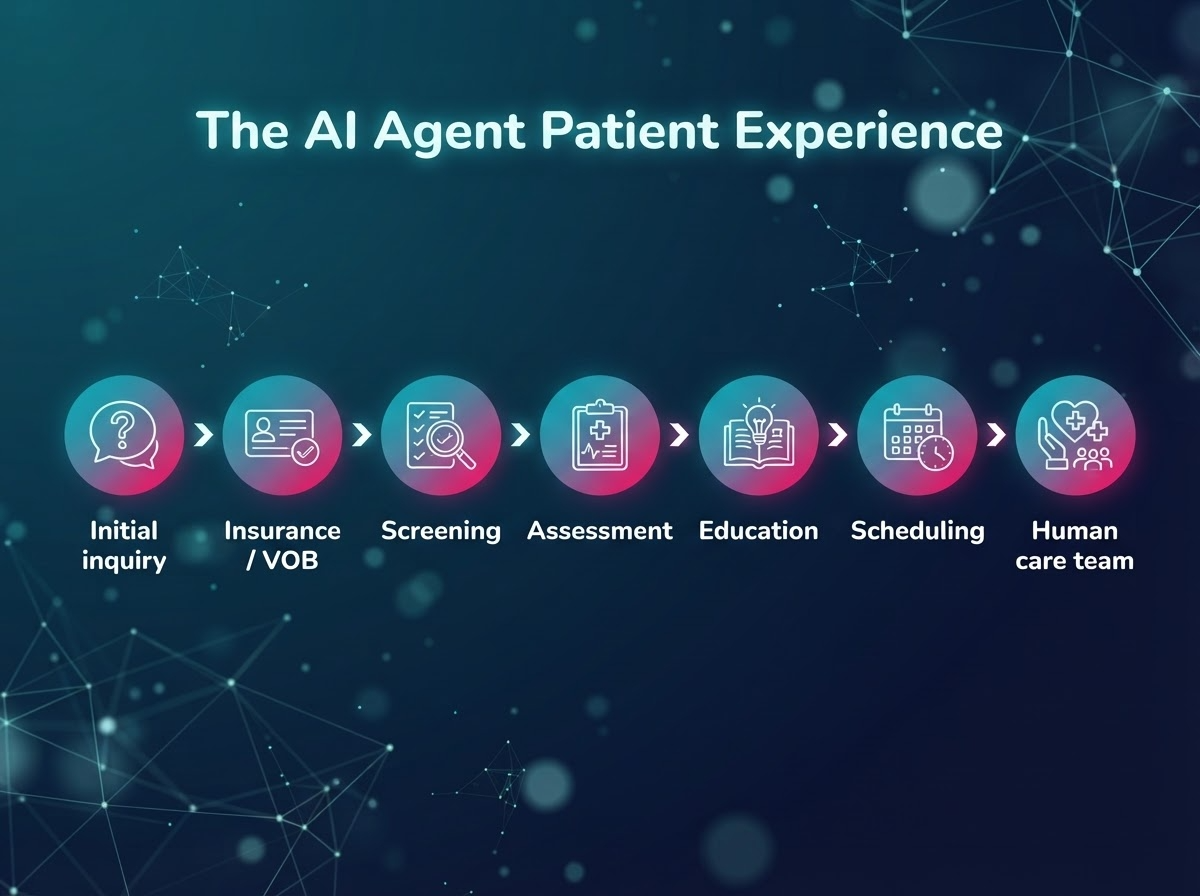
Initial inquiry → Insurance/VOB → Screening → Assessment → Education → Scheduling → Human care team
Botco.ai supports PHQ-9 assessments for Camelback, allowing standardized behavioral health screening to become part of the digital intake experience. The agent can also support assessment workflows such as TMS assessment, patient education, intake, scheduling, and completed VOB.
The important distinction is that this isn’t simply a chatbot answering FAQs.
The agent becomes part of the intake workflow.
And when a conversation requires clinical judgment, urgent intervention, or another situation outside the agent’s approved scope, the workflow can be designed to escalate to the appropriate human team.
How Botco.ai Can Support the Behavioral Health Journey
Botco.ai agents can support patients from the first inquiry through intake, screening, scheduling, and connection to the right care team. Applications include:
- Insurance and benefits verification: Collect the information needed to complete VOB and help move patients through eligibility and coverage workflows without unnecessary delays.
- Structured intake and screening: Guide patients through approved assessments such as the PHQ-9 and capture responses as structured data.
- Program and treatment education: Help patients understand available services, levels of care, locations, telehealth options, and what to expect from the intake process.
- Addiction treatment intake: Engage people when they are actively seeking help, begin intake and benefits verification, answer common questions, and move them toward admissions.
- Assessment and qualification: Guide patients through structured assessment workflows, including TMS assessment where appropriate.
- Appointment scheduling: Move patients from inquiry to a scheduled next step within the conversational experience.
- Human handoff and escalation: Recognize when a conversation requires a clinician, admissions specialist, or other team member and route it appropriately.
- Patient follow-up: Re-engage people who begin an intake, referral, or scheduling process but don’t complete the next step.
At Camelback Recovery, many of these capabilities are already being put into practice. Alicia supports the patient journey with capabilities including VOB, structured PHQ-9 screening, assessment, patient education, and intake and scheduling workflows.
The objective isn’t to replace clinical judgment. It’s to remove unnecessary administrative friction around it.
Don’t Forget the Referral-to-Appointment Gap
Treatment access problems don’t always begin with a patient searching for care. Sometimes the patient has already been referred—and still doesn’t make it into treatment.
Catalyst Counseling, LLC is a behavioral/mental-health provider, with a particularly strong focus on school-based mental health services for children and families in Ohio. They also provide outpatient and telehealth care.
Botco.ai’s work with Catalyst Counseling illustrates another application of AI agents in patient access. Catalyst Counseling uses Botco.ai to make behavioral-health referrals and onboarding easier, helping referred patients and families understand what they need to do next and move toward care through conversational web and SMS experiences. Botco.ai can support the journey from referral through onboarding and scheduling, while integrating with Catalyst’s Valant workflow.
Simplifying that journey matters, contributing to significantly better scheduling outcomes. Botco.ai also supports patient onboarding through Valent integration, school referral tracking, surveys, and ongoing patient engagement.
Treatment Access Extends Beyond Behavioral Health
The same principle applies wherever patients face complicated pathways into specialty care.
AndHealth, for example, specializes in complex autoimmune conditions across areas including dermatology and rheumatology. Patients researching these conditions can arrive with detailed questions about their diagnosis, treatment options, insurance, and care journey—and many arrive outside normal business hours.
Botco.ai provides a conversational front door that can educate patients about their conditions and care journey, understand their needs, qualify inquiries, and guide them toward scheduling a telehealth call.
That means a patient who arrives at 10 p.m. doesn’t simply encounter a contact form and wait until the next business day.
The organization can begin helping them while their intent is high.
For complex specialty care, treatment access isn’t a single transaction. It’s navigation.
Clinical Trial Matching Is Another Form of Treatment Access
Treatment access can also mean helping clinicians connect patients with appropriate clinical trials without requiring them to manually navigate complex eligibility criteria and referral processes.
Botco.ai’s OncoTrial Match for UCLA Health uses a conversational SMS workflow to help clinicians identify fitting oncology clinical trials and initiate the referral process.
The workflow guides the clinician through a structured series of questions, including the patient’s location and travel radius, cancer type, and disease-specific information. For the current workflow, supported cancer types include cervical, ovarian, and endometrial cancers.
Based on those responses, OncoTrial Match presents fitting trial options for the clinician to review and select. Once a trial is selected, the workflow goes a step further: it generates an automated referral email to the clinical trial site, with the referring doctor copied.
That distinction matters. The agent isn’t simply providing information about available trials. It helps move the process forward:
Patient information → Disease-specific questions → Trial matching → Clinician selection → Automated referral
For healthcare organizations, this illustrates a broader opportunity for AI agents: reducing the administrative steps between identifying an appropriate next step and actually initiating it.
The Best Healthcare AI Agents Reduce the Distance to Care
Coverage verification is a compelling place to start because the value is immediately understandable: a patient wants care, and administrative work is standing between them and the next step.
But the larger opportunity is connecting those steps.
Coverage verification. Screening. Intake. Education. Qualification. Scheduling. Referral navigation. Follow-up.
When each is treated as a separate process, patients experience the gaps between them.
When AI agents are integrated into the underlying workflows, the experience can become much more continuous—and staff can spend less time managing repetitive administrative tasks.
For regulated healthcare organizations, that also means designing agents around appropriate permissions, guardrails, escalation paths, and secure handling of patient information. Botco.ai is an enterprise AI agent platform built for regulated industries and is HIPAA validated and SOC 2 Level 2 compliant, with configurable human handoff and hybrid AI + human workflows.
Because healthcare AI shouldn’t create another place for patients to wait.
It should help them get to the right next step faster.
Ready to Reduce Friction in Your Patient Access Journey?
From coverage verification and intake to screening, scheduling, and patient navigation, Botco.ai can help turn conversations into the next step in care.